These days, more and more people are drinking filter coffee at home, and it seems…
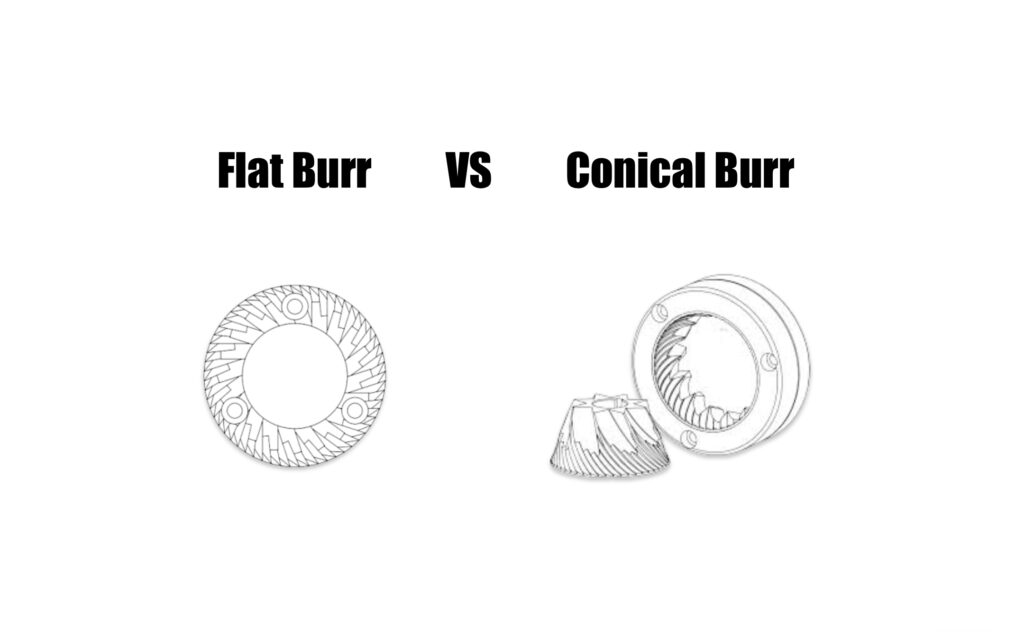
Flatt Burr VS Conical Burr
Pros and Cons of Flat Burrs and Conical Burrs, and the Differences in Coffee Flavor
It’s always been said that the most important factor in brewing delicious coffee is quality coffee beans.
It goes without saying that good ingredients lead to good brewing results.
Once you’ve secured quality beans, the next most important factor is the coffee grinder.
I mentioned that even grinding and even saturation are key.
If you purchased quality beans but the taste isn’t as good as you’d expect, the issue is most likely your grinder’s grinding performance.
That’s why a coffee grinder that grinds evenly is so important.
Now, we’ll take a closer look at this coffee grinder.
Coffee grinders are equipped with special blades that grind coffee beans. These are called burrs.
You’ll notice that they look quite different from the blades found in blenders.
Some coffee grinders come with these blades, but they don’t guarantee a consistent grind, so they should be avoided.
For the same reason, grinding coffee in a blender is not recommended.
Now, let’s take a look at how grinder burrs grind coffee.
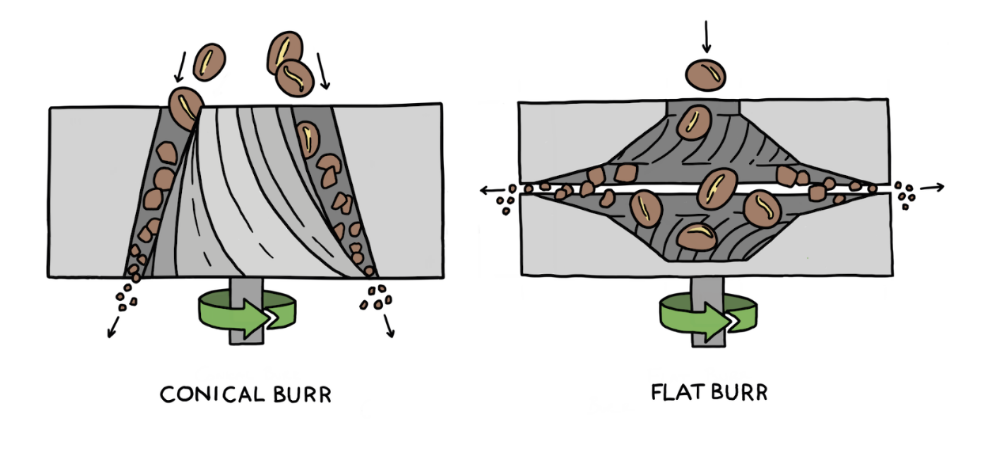
Burrs essentially grind coffee beans into a consistent size through a crushing and cutting motion.
The coffee beans are trapped between the burrs, breaking them into smaller pieces, and then the blades cut them into a consistent size before discharging them.
The coffee industry currently places great importance on how evenly the grinder burrs grind the coffee.
Burrs are broadly divided into two types: flat and conical burrs, depending on their shape.
Flat burrs consist of a pair of disc-shaped burrs that grind coffee.
Conical burrs consist of a pair of cone-shaped burrs and a ring-shaped burr that grind coffee.
What’s the difference between these two?
Of course, the burr shapes are different, but the difference lies in the two main actions involved in grinding coffee: crushing and cutting.
Flat burrs tend to focus more on cutting than crushing, while conical burrs focus more on crushing.
Assuming the same diameter, a conical burr with a wider crushing surface grinds much faster than a flat burr, but it also produces more fines.
The reason conical burrs are found in almost all hand grinders is their high grinding speed relative to their size.
On the other hand, flat burrs, which focus on cutting, produce less fines, but have the disadvantage of a slower grinding speed than conical burrs of the same diameter.
In terms of grinding quality, flat burrs with fewer fines produce a more uniform grind.
You might think flat burrs are better, but to compensate for the slow speed, the burrs rotate rapidly. This can lead to heat generation and static electricity, which can result in a loss of flavor.
Therefore, while large-diameter flat burrs are increasingly preferred, grinders equipped with these large flat burrs often come at a significantly higher price point.
Now that we’ve looked at the mechanisms of flat and conical burrs, let’s move on to the most important and fundamental question:
How does the taste of coffee differ when ground with a flat burr or a conical burr?
As you can see from the graph, flat burrs clearly express one or two characteristic flavors of the bean, whereas conical burrs, due to their fine grind, reveal some aromas other than the main aroma of the bean.
For example, the main aromas of Ethiopia Momora Washed beans are citrus and chocolate.
When these beans are ground with flat burrs, the citrus and chocolate aromas are clearly perceived.
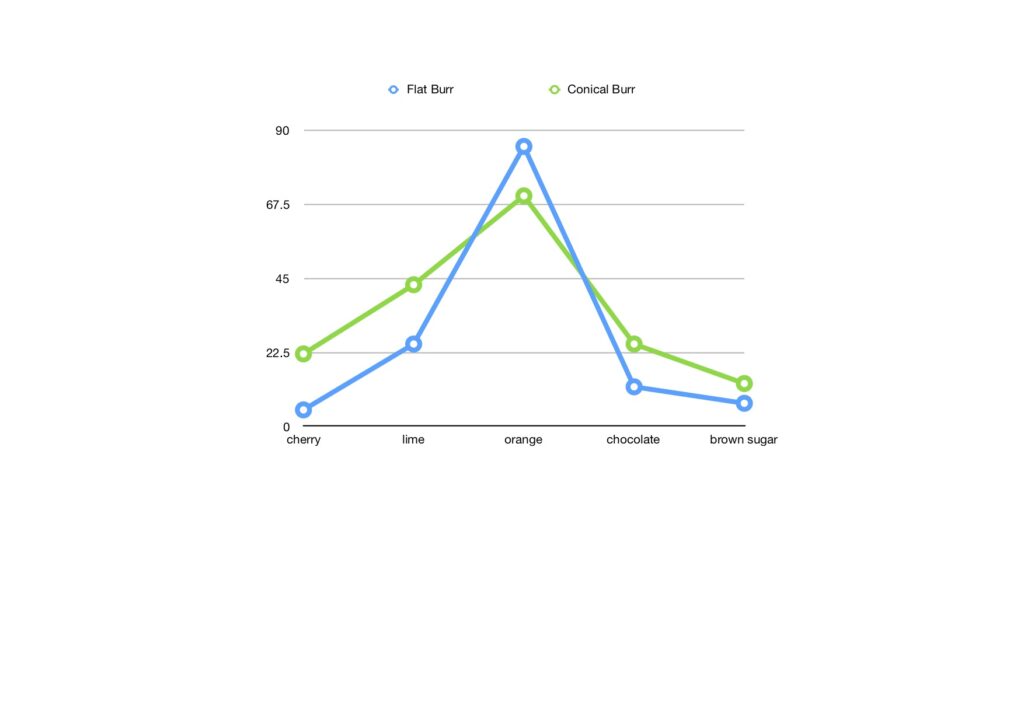
On the other hand, when these beans are ground with a conical burr, you’ll detect a bit of other flavors, such as cherry, in addition to the citrus and chocolate notes.
This effect becomes more pronounced as the grind size becomes finer. While this difference might not be noticeable when grinding for filter coffee, it becomes noticeable when brewing espresso with a finer grind.
Therefore, when brewing with a coffee machine, the taste of the coffee can differ significantly depending on whether you use a flat or conical burr.
This isn’t a matter of one being better than the other; it’s a matter of personal preference.
If you want to emphasize one or two distinct flavors, a flat burr is recommended, while if you prefer a variety of aromas, a conical burr is recommended.
However, as mentioned earlier, in drip coffee, impurities are filtered out by the filter, so the difference isn’t as noticeable.
Therefore, for those who enjoy drip coffee, it’s better to focus more on the uniformity of the grind size of the grinder than on the type of burr.

Comments (0)